
For generations, tuberculosis (TB) has shaped lives quietly and brutally across Lesotho, especially among men who spent years working underground in the mines. Today, Partners In Health (PIH) Lesotho is changing that story through its TB Elimination Project, a bold, community-centered approach that takes screening, diagnosis, and care directly to the people most at risk.
At the heart of this effort is Khethang Ntsata, a 65-year-old father of four from Mohale’s Hoek. His life reflects both the long shadow of TB and the power of early detection when care reaches people before it is too late.

Khethang Ntsatla in a mobile clinic truck receiving services from the PIH community team during the TB Elimination outreach
Photo by Justice Kalebe / PIH
A Life Shaped by the Mines and the First Encounter with TB
Ntsata worked in the mines from 1996 to 2011, spending 15 years underground breathing in dust that would later take a serious toll on his lungs. Like many former mineworkers, the impact of those years did not end when he returned home.
In 2021, Ntsata was diagnosed with drug-susceptible tuberculosis (DS-TB) for the first time. DS-TB is a form of tuberculosis caused by Mycobacterium tuberculosis bacteria that are sensitive to all first-line anti-TB drugs, specifically isoniazid and rifampicin.
After feeling unwell, he visited a private doctor, where an X-ray revealed severe lung damage. He was told there were holes in his lungs and was referred to Mohale’s Hoek District Hospital, where the TB diagnosis was confirmed.
He was initiated on TB treatment and informed it would last six months. However, the treatment continued for eight months. Although the TB was cured, he was left with post-TB lung disease and permanently scarred lungs.
“When I first went to the health center, it was because I was always tired,” Ntsata recalls. “Even when I did nothing, I felt exhausted.”

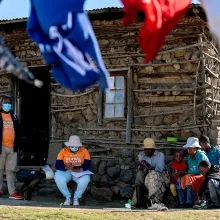
Khethang Ntsata (right) receives services from the PIH TB Elimination team during a community outreach
Photo by Justice Kalebe / PIH
A Strategic Approach: Search, Treat, Prevent
PIH Lesotho’s TB Elimination Project is built around an innovative, multi-pronged approach: Search, Treat, and Prevent. The project intensifies community outreach to identify both latent and active TB cases, using the PIH-designed TB Hunter data system for real-time program management and to guide testing and contact tracing. Decentralized diagnostic tools allow TB confirmation at the point of care, while Geographic Information Systems mapping identifies TB hotspots for mass community screening and active contact tracing. Once TB is confirmed, drug-sensitive TB patients are linked to care and social support at local health centers, drug-resistant TB patients are referred to Nt’sekhe Hospital, and critically ill cases are sent to PIH-supported Botšabelo Hospital. Post-TB lung disease is also screened and managed. At the same time, preventive measures are strengthened: community contact tracing is conducted by nurses, and TB Preventive Treatment (TPT) is initiated at both the community and facility level for eligible individuals. The TB Hunter system monitors confirmed linkages and TPT adherence, ensuring patients remain on track throughout their care journey.
Living with the Aftermath and the Fear of TB Returning
After completing treatment in 2021, Ntsata lived well for several years. But living with damaged lungs meant living with constant fear. TB had left scars, both physical and emotional.
In early 2026, he began losing his appetite. The symptoms felt familiar. Having survived TB once before, he feared it might be back.
“I know how TB feels,” he says. “When my body started changing again, I became worried.”

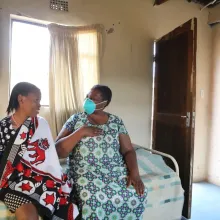
Khethang Ntsata (right) receives services from Nomondiza Sithole, PIH TB Nurse (left), during TB Elimination community outreach
Photo by Justice Kalebe / PIH
From Community Diagnosis to Immediate Linkage to Care
Early detection and immediate linkage to care are central to PIH Lesotho’s TB Elimination strategy.
“When we find TB patients during community activities, we act immediately,” explains PIH Community Nurse Seabata Ntsibane. “We refer them straight to their local health facility to start and continue TB treatment. At the facility, the patient is given a patient number, which makes it easier for us to trace them and monitor their treatment progress. Whether the patient has TB or a non-communicable disease, the transfer ensures continuity of care.”
Before each outreach, the TB Elimination community liaison officer engages directly with communities to create awareness and encourage people to come forward for testing.
“Clinical community outreaches are essential for searching for TB presumptive cases,” says TB Elimination Community Liaison Officer Maleshoane Seleke. “They help us identify people early and make sure treatment is started immediately. Without these outreaches, many people would only reach health facilities when they are already very sick.”

Mobile X-ray truck during the TB Elimination community outreach in Mohale’s Hoek
Photo by Justice Kalebe / PIH
Mobile Clinics, Same-Day Answers, and a New TB Response
A defining feature of the TB Elimination Project is the mobile TB clinic trucks, which bring advanced diagnostics directly to communities. Each outreach team includes a doctor, two nurses, a laboratory technician, and an X-ray assistant.
Dr. Sebakeng Phate, PIH Lesotho’s multidrug-resistant TB associate lead, explains the process: “When a patient is referred for an X-ray at the mobile clinic, the scan is done on-site inside the truck using digital equipment. The image is available immediately and reviewed by a doctor on the spot.”
The patient is informed immediately whether the X-ray shows signs suggestive of TB. If TB is suspected, the patient is counselled immediately on the next steps, including linkage to care. Patients leave knowing their TB status and what action needs to be taken.”
For Ntsata, being diagnosed early meant clarity, reassurance, and fast action. For PIH Lesotho, it demonstrated exactly how the TB Elimination Project is meant to work.
In its first phase, the project aims to detect and treat 5,151 people with TB over five years, starting in high-burden districts like Mohale’s Hoek. By combining community mobilization, mobile diagnostics, and strong referral systems, PIH Lesotho is building a model that can be scaled nationally.
Ntsata’s story shows the difference between waiting for TB to find you and taking services to where people live.
Through the TB Elimination Project, PIH Lesotho is ensuring that when TB comes, it is met early, treated immediately, and stopped in its tracks.