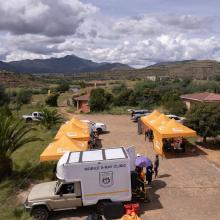

The first people to arrive at the outreach are often elderly villagers, mothers carrying children on their backs and men returning from the fields. One by one they make their way beneath the outreach tents where an entire healthcare system has been brought directly into their community.
For many, this is the first opportunity to receive comprehensive tuberculosis screening without travelling long distances to a health facility. What begins as a simple registration soon becomes a carefully coordinated journey through one of the most comprehensive community TB programmes in Lesotho.
Each patient follows the same pathway, with every member of the PIH Lesotho team playing a critical role in ensuring that no case of tuberculosis is missed.

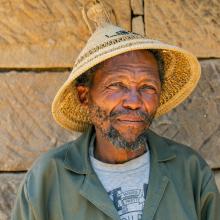
Pheta Ratemane arriving at the TB Elimination Outreach.
Photo by Justice Kalebe / PIH
The TB Screener: The First Conversation That Could Save a Life
Every patient’s journey begins with PIH TB screener, who welcomes community members and records their details into the PIH-designed TB Hunter electronic data system.
But registration is far more than collecting names.
As patients take their seats, the TB screener begins asking questions that may seem ordinary, yet have the power to reveal a disease that often hides in plain sight. On this day, the responsibility fell to TB screener Kamohelo Rasehloho, who carefully guided each patient through an intensified TB screening process. Rather than focusing only on the familiar signs of tuberculosis, the screening takes a broader TB risk factor and symptom approach, asking patients about a range of symptoms, including cough, shortness of breath, blood in sputum, lumps in the neck or groin, increased abdominal swelling (ascites), weight loss, fever, and night sweats.
The screening also looks beyond symptoms to identify TB risk factors that may increase a person’s likelihood of having TB. Rasehloho asks whether the patient has had a known household contact with TB or whether someone in the family has died due to an unknown illness. Patients are also asked whether they have ever worked as a miner or been incarcerated, whether more than five people live in their household, and whether they or their household have experienced food insecurity. The screening further considers age, particularly whether the patient is older than 50 years, as well as patterns of repeated healthcare seeking, such as having had repetitive consultations for the same illness. By bringing together both symptomatic and risk-factor screening, the process helps identify people who may otherwise be missed, including those whose TB symptoms may not be immediately obvious.

Pheta Ratemane (right) being screened by Kamohelo Rasehloho (TB Screener) for tuberculosis.
Photo by Justice Kalebe / PIH
Each answer builds a picture of the patient’s health while simultaneously creating a digital record that follows them throughout their entire care journey.
“People often think we are simply registering them, but we are already screening for tuberculosis from the very first conversation,” explains Kamohelo Rasehloho. “Every question we ask helps us identify people who may need further investigations. We capture everything in TB Hunter so that every patient can be followed from screening through treatment and follow-up care. Nothing is left to chance.”
Patients whose symptoms suggest possible TB are immediately referred to the next station for further assessment.

Pheta Ratemane waiting to be screened in the mobile truck.
Photo by Justice Kalebe / PIH
The TB Nurse: Looking Beyond Tuberculosis
The next stop is with PIH TB Nurse Katleho Seisa, who believes that diagnosing TB means understanding the whole patient, not just the disease.
Before any laboratory tests are performed, he carefully carries out a comprehensive clinical assessment. Blood pressure is measured, blood sugar is checked, and the patient’s medical history is reviewed. The assessment also considers HIV status and other conditions that commonly occur alongside tuberculosis.
For Katleho, this stage is about understanding the complete picture.
“Tuberculosis rarely exists on its own,” he explains. “Many of our patients also have diabetes, hypertension or HIV, and these conditions influence how we care for them. We assess every patient thoroughly so that when treatment begins, we are treating the whole person rather than focusing on only one disease.”
The information gathered during this assessment guides the next steps of the patient’s journey and helps clinicians decide which additional investigations are needed.
The primary assessment and the sample collection happens simultaneously.

Pheta Ratemane taking and x-ray in the mobile truck.
Photo by Justice Kalebe / PIH
The Laboratory Technician: Every Sample Tells a Story
During the outreach, PIH Laboratory Technician Tšepo Tšumane knows that accurate diagnosis begins long before a machine analyses a specimen.
It begins with collecting the right sample.
Working alongside the nurse, Tšepo carefully explains how patients should produce sputum from deep inside their lungs rather than simply providing saliva. Once collected, every specimen undergoes meticulous quality checks. Patient identities are confirmed, laboratory forms are verified and the sample is securely packaged inside biohazard zip bags before testing.
These careful procedures ensure that every result clinicians receive can be trusted.
“GeneXpert can only give us an accurate answer if we provide it with a quality sample,” explains Tšepo Tšumane. “We take great care during collection because every sample represents someone’s life. We verify the patient’s details, package everything correctly and make sure the specimen reaches testing in perfect condition. Accuracy starts with us.”
The sputum is then processed using GeneXpert technology, which detects the genetic material of the TB bacteria and can identify both tuberculosis and possible drug resistance within hours.

PIH X-ray assistant Refiloe Mapalane reviews x-rays captured while screening for tuberculosis in Ha Mapotsane village during outreach.
Photo by Justice Kalebe /PIH
The Doctor: Bringing Every Piece Together
By the time patients reach PIH MDR-TB Doctor Mpho Mphahama, every stage of the outreach has contributed another piece to the puzzle.
The patient’s symptoms, clinical assessment, AI-assisted chest X-ray, laboratory investigations and digital records in TB Hunter are reviewed together, allowing decisions to be made quickly and accurately.
For Dr. Mphahama, the outreach represents a fundamental shift in how tuberculosis care is delivered.
“The TB Elimination Project was established after Partners In Health recognised that Mohale’s Hoek carries the highest burden of tuberculosis in Lesotho,” he explains. “Instead of waiting for patients to travel long distances to health facilities, we asked ourselves how we could bring comprehensive TB services directly into the communities where transmission is taking place.”
Working closely with the District Health Management Team and Ntšekhe Hospital, PIH identifies priority villages using GIS mapping and community data before planning outreach activities that aim to reach entire populations.

Pheta Ratemane (right) is screened for tuberculosis by Dr. Mpho Mphahama.
Photo by Justice Kalebe / PIH
“Our approach follows three simple principles: Search, Treat and Prevent,” says Dr. Mphahama. “We actively search for people with tuberculosis, diagnose them using advanced point-of-care technologies and begin treatment immediately whenever possible. Early diagnosis breaks the chain of transmission and prevents more infections within families and communities.”
The outreach extends beyond pulmonary tuberculosis. Patients are screened for extrapulmonary TB using TB LAM and point-of-care ultrasound, while HIV testing, diabetes screening and hypertension checks are integrated into every outreach. Those diagnosed with drug-sensitive TB are linked directly to their nearest health centre for continued treatment. Patients with drug-resistant TB are referred to Ntšekhe Hospital, while critically ill patients receive specialised care at PIH-managed Botšabelo MDR-TB Hospital.
Throughout the entire process, TB Hunter continues to monitor every patient’s journey, tracking diagnosis, treatment initiation, contact tracing and TB Preventive Therapy for eligible household contacts.
“Our goal is not only to diagnose tuberculosis,” Dr. Mphahama says. “Our goal is to find it early, treat it immediately and prevent it from spreading any further. Every patient we diagnose early is another opportunity to protect an entire family and move one step closer to eliminating TB in Mohale’s Hoek.”
As the outreach comes to an end and the last patients leave with medication, referrals or reassurance, the team begins packing away its equipment. The tents may disappear until the next village, but the impact remains. Behind every consultation is a patient who was found, tested, treated and connected to ongoing care; proof that bringing healthcare to the community is bringing Lesotho closer to ending tuberculosis.

Pheta Ratemane leaving the outreach.
Photo by Justice Kalebe / PIH