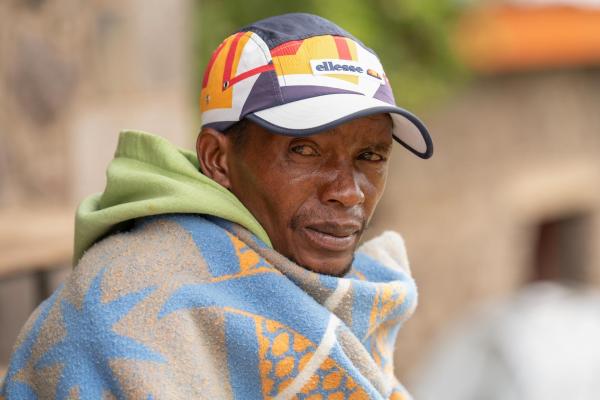
When 47-year-old Semethe Moshesha finally decided to seek help for the emotional turmoil he was carrying, he set out on a journey that took him 3-4 hours on horseback to reach Tlhanyaku Health Center, one of Partners In Health (PIH) Lesotho’s rural initiative (RI) sites. His first point of contact followed PIH Lesotho’s established Care Pathways; beginning with routine screening for every patient who arrives, where individuals are checked for non-communicable diseases and tuberculosis. After initial screening, each patient proceeds through one of four service points: the outpatient (OPD) corner, the antiretroviral therapy (ART) corner, the tuberculosis (TB) corner, or the maternal and child health (MCH) corner.
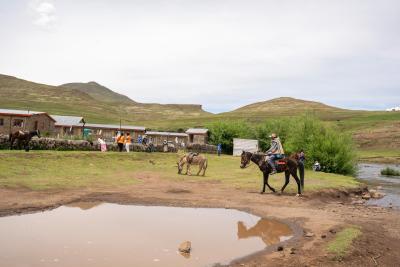
Semethe Moshesha, arriving at Tlhanyaku Health Centre, for mental health services.
Photo by Justice Kalebe / PIH
At his OPD consultation, a PIH nurse guided him through the standard mental health screening process using the first two questions of the Patient Health Questionnaire (PHQ-9), administered to every patient at intake. His responses revealed deep emotional distress; he no longer found pleasure in activities he used to enjoy and felt a persistent sense of hopelessness.
Moshesha was referred to the mental health department, where a professional PIH counsellor re-screened him. His scores on both PHQ-9 and the Generalised Anxiety Disorder 7 (GAD-7) indicated high levels of depression and anxiety. With this, he was enrolled into the Problem Management Plus (PM+) program.
The Power of Screening
At Tlhanyaku Health Center, screening is a vital gate through which silent suffering is discovered and addressed. Patients who score between 1-4 on the tools receive counselling and are discharged. Those scoring 5 and above are enrolled directly into the PM+ program: ensuring they receive structured psychological intervention.
Session by session, Moshesha began to unpack what had been weighing on him. He learned to break overwhelming worries into manageable steps and to use breathing exercises to steady his heart and quiet his thoughts.
His emotional distress stemmed from a painful erosion of dignity within his own home. After his wife began working while he remained unemployed, he slowly felt stripped of respect; not just from her, but from their three children.
“The problem started when my wife started working. The way she treated me changed, and soon even the children treated me the same. I could not think straight anymore. I lost focus. I lost myself.”
Once a committed subsistence farmer, he found himself losing interest in farming, losing motivation to work, and isolated himself from everyone.
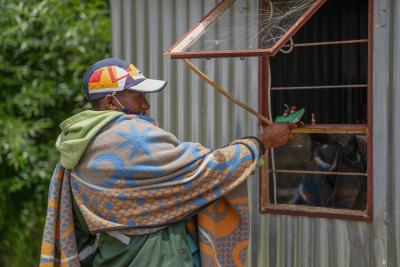
Semethe Moshesha at the Tlhanyaku Health Center screening point.
Photo by Justice Kalebe / PIH
Psychosocial Support: Gardening as Therapy
The PM+ program unfolds in five progressive sessions, each designed to rebuild emotional capacity and restore resilience:
1. Stress Management through Breathing Exercises
“Learning to control my breathing helped me feel calmer and more in control of my emotions,” Moshesha said.
2. Problem Solving
“It was empowering to realize that I could tackle my problems one step at a time,” he shared.
3. Get Going-Keep Doing
“The session helped me see that my life wasn’t over, that I could still find joy and purpose.”
4. Strengthening Social Support
“PIH councillor through its PM+ intervention made me to reconnect with friends and neighbours who could support me during my recovery,” he noted.
5. Stay Well
“We discussed strategies to stay healthy and manage stress in the long term,” he explained.
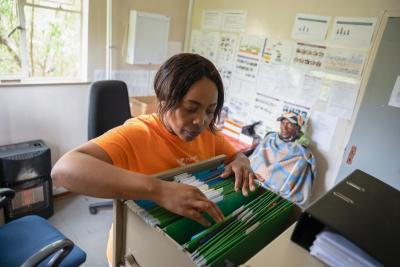
Tšepiso Mokhele, PIH Lesotho’s professional counsellor, assisting Semethe Moshesha at Tlhanyaku Health Centre.
Photo by Justice Kalebe / PIH
During session five, Moshesha received vegetable seeds as part of PIH’s psychosocial support; an activity designed to inspire action, routine, and hope. Gardening became a ritual of emotional reset:
“When I feel overwhelmed, I go to my garden and look after the vegetables I planted from those seeds. By the time I go back inside my house, I feel lighter.”
He shared that at the peak of his depression, he wanted nothing but to sleep and be alone. But now, his love for farming is resurfacing. He has learned to take everything step by step.
Strengthening Screening and Care: Tšepiso Mokhele on PHQ-9 and GAD-7
Tšepiso Mokhele, one of PIH Lesotho’s professional counsellors at Tlhanyaku Health Center, explains the critical importance of these tools:
“The Patient Health Questionnaire (PHQ-9) and the Generalised Anxiety Disorder 7 (GAD-7) are essential tools because they help us understand the depth and nature of a person’s emotional suffering. PHQ-9 helps identify signs of depression, while GAD-7 helps us measure anxiety levels. These allow us to tailor support and ensure that patients who need PM+ are enrolled quickly and appropriately. When we identify early indicators through these tools, we can intervene with counselling and coping strategies before emotional distress becomes crisis.
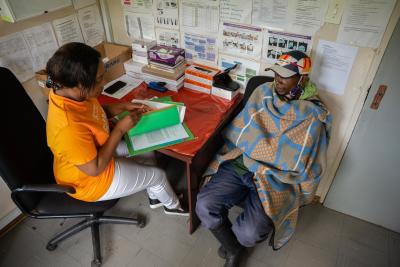
Tšepiso Mokhele consulting patient Semethe Moshesha at Tlhanyaku Health Centre.
Photo by Justice Kalebe / PIH
Today, there are 30 enrolled patients in the PM+ program at Tlhanyaku Health Center, with only 2 who have defaulted; an encouraging sign of engagement and hope.
Moshesha still faces challenges at home; but now, he faces them with tools, calm, and inner steadiness. What once felt like a silent collapse has become a quiet rebuilding.
One horseback journey at a time, one session at a time, and one vegetable seed at a time; Semethe is finding his footing again.