In FY25, Partners In Health (PIH) Lesotho reached a historic milestone in the fight against HIV: all seven of its Rural Initiative (RI) sites achieved 0% vertical transmission of HIV from mother to child. A cohort of 76 HIV-exposed infants (HEI) tested negative, marking a significant victory for maternal and child health in Lesotho and offering hope for an HIV-free generation.
This achievement reflects PIH Lesotho’s holistic and patient-centered approach to eliminating mother-to-child transmission (EMTCT). At the heart of this success is the PIH 5S Model, which ensures that every mother living with HIV receives the care, support, and resources necessary to deliver an HIV-free child.
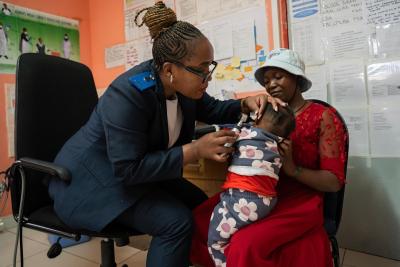
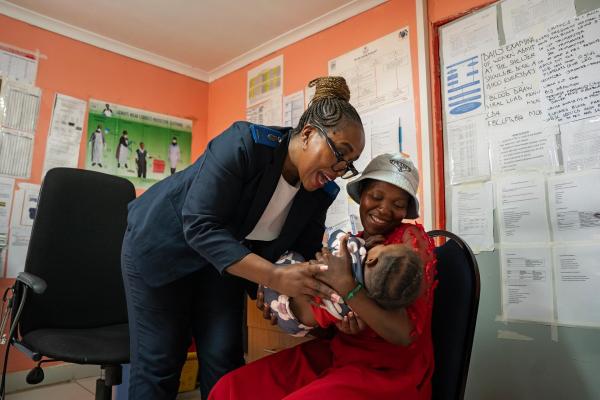
Partners In Health Lesotho nurse Thandy Ketsia Tsoke (left), examines Mathabelang Motselekatse’s 10-month-old daughter, Tlhokomelo, during their check-up at Nohana Health Center.
Photo by Justice Kalebe / PIH
The 5S Model in Action
- Staff: Dedicated clinicians, nurses, and councillors provide counselling, adherence support, and routine follow-up for mothers and infants.
- Stuff: Starter packs for antenatal care (ANC) visits, essential medical supplies, ARVs, and infant prophylaxis ensure that mothers remain engaged in care. Multi-month ARV supplies reduce the burden of frequent clinic visits and support continuous treatment adherence.
- Space: Maternal waiting homes constructed at rural clinics give expectant mothers a safe place to stay before delivery, minimizing risks from long travel distances. Mini-laboratories at RI sites provide rapid HIV testing and viral load monitoring, enabling timely interventions.
- Systems: Strong referral networks, data-driven monitoring, and routine viral load testing guarantee that no mother or infant is left behind. High viral suppression rates among mothers drastically reduce the likelihood of transmission.
- Social Support: At the health centre, mothers receive ongoing counselling, adherence support, and infant monitoring, critical services that ensured viral suppression and contributed to achieving 0% vertical transmission.
Voices from the Frontline
Reflecting on this milestone, Rorisang Lerotholi, Nurse-in-Charge at Nkau Health Center, said:
“It’s a good thing that we were able to achieve 0% vertical HIV transmission from mother to child. Under EMTCT there are four areas of focus: the first is to eliminate HIV infection in childbearing-age women; the second is to prevent unintended pregnancies in women living with HIV; the third is to ensure safe pregnancies, deliveries, and breastfeeding periods; and the fourth is to provide support and treatment to women already living with HIV and their babies.”
She also highlighted the importance of strong systems in maintaining adherence and care continuity:
“Systems like Moriana and Open MRS help us in terms of adherence because they allow us to determine and track if HIV-positive pregnant mothers are taking their treatment well. We do this by comparing their paper-based files with these systems.”
Dedication extending far beyond the walls of the health centers:
“Our contribution is also through our staff doing health education in our facilities and periodically in our outreaches. We use horses to get to our outreaches, and we also provide supplies through the ‘stuff’ component of our 5S Model, which includes among others PrEP and condoms. Through the same component, we also provide patient-based family planning. Our staff have expertise in administering family planning commodities to ensure maximum health outcomes.”
Lerotholi highlighted how maternal waiting homes have been crucial to safe deliveries and ongoing support for mothers:
“We make sure that pregnant women are safe by booking them into maternal waiting homes at 36 weeks to ensure safe delivery. Through our social support component, if women experience or are prone to complications, we refer them to hospitals free of charge and cover their medical bills fully. At our maternal waiting home, we provide pregnant women with 100% support by ensuring they get nutritious meals and take their HIV medication accordingly so that their HIV is suppressed. We also book them for postnatal care, and if they miss an appointment, we fetch them to ensure that breastfeeding is satisfactory. We give them health education and practical demonstrations of how breastfeeding should be done.”
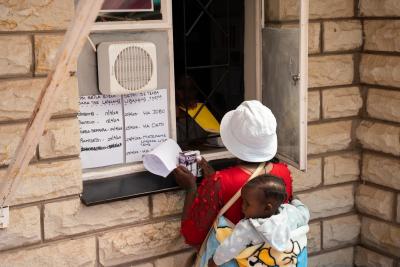
Mathabelang Motselekatse (30), from Mafikeng village, and her 10-month-old daughter, Tlhokomelo, picking up medication following their check-up at Nohana Health Center
Photo by Justice Kalebe / PIH
Infrastructure and Innovation Driving Success
PIH Lesotho has perfected clinical excellence with strategic investments in infrastructure and innovation: maternal waiting homes, mini-laboratories, starter packs for ANC visits, and multi-month ARV supplies all contribute to sustained engagement in care. These measures make it easier for women in hard to reach areas to access essential services, adhere to treatment, and deliver their babies safely.
A Model for PIH Rural Initiative Sites and Beyond
Achieving 0% vertical transmission across seven RI sites demonstrates that with comprehensive care and strong health systems, Lesotho can protect mothers and infants from HIV. PIH’s integrated EMTCT program shows that even in resource-limited settings, an HIV-free generation is possible.
This milestone is not only proof to clinical and programmatic excellence but also a symbol of hope for families across PIH Lesotho’s sites.