When the TB Elimination Project arrives in a village, it brings much more than TB screening.
For many community members, the outreach serves as a rare opportunity to access a range of primary health care services close to home. Alongside TB screening, community members receive health assessments, screening for non-communicable diseases (NCDs), referrals for ongoing care, and health education that can help identify illnesses before they become severe.
This integrated approach is particularly important in remote communities where distance, transport costs, and limited access to health facilities often prevent people from seeking timely care.
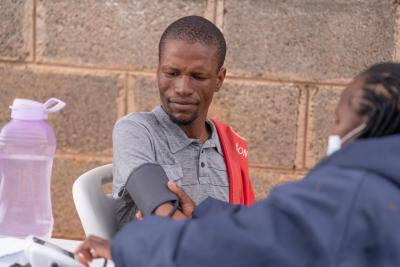
Nomondiza Sithole, PIH TB nurse checking Tšepo Boy’s blood pressure during TB Elimination outreach.
Photo by Justice Kalebe / PIH
For Mabafokeng Pholo, a 42-year-old community health worker from Tlokoeng in Mohale’s Hoek, the value of bringing primary health care services directly into communities is clear.
Having worked as a community health worker since 2014, she regularly sees people delay seeking medical attention until their conditions have worsened.
“Many people do not go to health centres until they are very sick,” she says. “When services are brought closer to the community, people are more willing to come for check-ups and find out about their health early.”
Pholo attended the outreach for a routine health assessment and believes the initiative helps bridge critical gaps in healthcare access for rural populations.
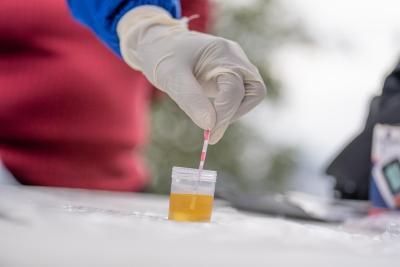
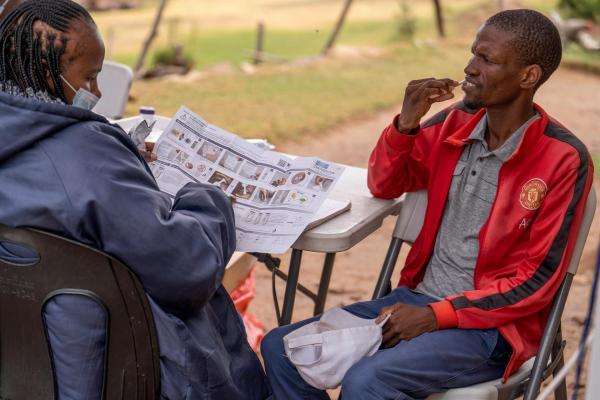
Urine testing.
Photo by Justice Kalebe / PIH
The TB Elimination outreaches also provide reassurance to individuals like a 47-year-old ‘Mareatile Mokhosi, who came for TB screening and a general health check-up. Having cared for her husband during his TB treatment years earlier, she wanted to monitor her own health while also accessing other primary care services available during the outreach.
After undergoing TB screening, sputum testing, and a chest X-ray, she was found not to have TB. She also received screening and follow-up support for ongoing chronic health needs.
“Outreaches like these allow us to check our health in one place,” she says. “It helps us know our status and get help before problems become serious.”
For 62-year-old ‘Majobere Nkaki, the outreach offered an opportunity to seek care after experiencing persistent health concerns. Living far from the nearest health facility, she welcomed the convenience of receiving services within her own village.
“Our clinics are very far away,” she says. “The outreach brings healthcare closer to us. It saves us from travelling long distances and helps us access services we might otherwise postpone.”
Through the outreach, Nkaki received a comprehensive health assessment, including screening for conditions beyond TB, ensuring that she could be referred for appropriate care if needed.
The importance of integrated primary health care services is also evident in the story of 56-year-old Pheello Lethoko, a cancer survivor and former mineworker from Tlokoeng village.
Lethoko attended the outreach following community mobilization efforts by the TB Elimination team. While he came for a general health check-up, the visit also provided an opportunity to review his medical history, assess his current health status, and connect him to any follow-up services he may require.
“Having these services in the community helps people who may not be able to travel easily,” he says. “It gives us a chance to know how we are doing and get help when we need it.”
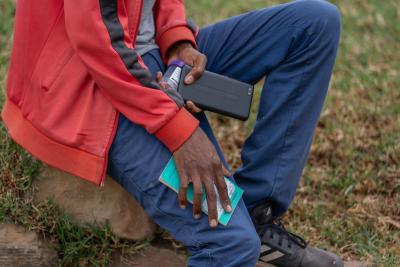
Tšepo Boy holding a health booklet and a sputum bottle.
Photo by Justice Kalebe / PIH
By integrating TB screening with broader primary health care services, the TB Elimination Project is helping communities access care that extends beyond a single disease. The model recognises that people do not experience health challenges in isolation. Someone who comes for a TB test may also need blood pressure monitoring, diabetes screening, chronic disease management, health education, or referral to additional services.
In this way, each outreach becomes more than a TB intervention. It becomes a gateway to primary health care, bringing essential services directly to communities that need them most and helping ensure that people receive the right care, at the right time, and as close to home as possible.